
Tasmanian Summit Presentation
Quantum in 2026

Yesterday I had the privilege of leading off the 2026 Tasmanian Quantum Summit. Australasia is an important contributor to the quantum ecosystem and I was honoured to represent the Quantum Strategy Institute and its’ focus on the intersection of quantum and business strategy, in this case in the 2026 context.

Image source: Brian Lenahan/Midjourney
Here’s my presentation:
“Quantum Business Strategy in 2026 – From Experimentation to Strategic Value Creation”
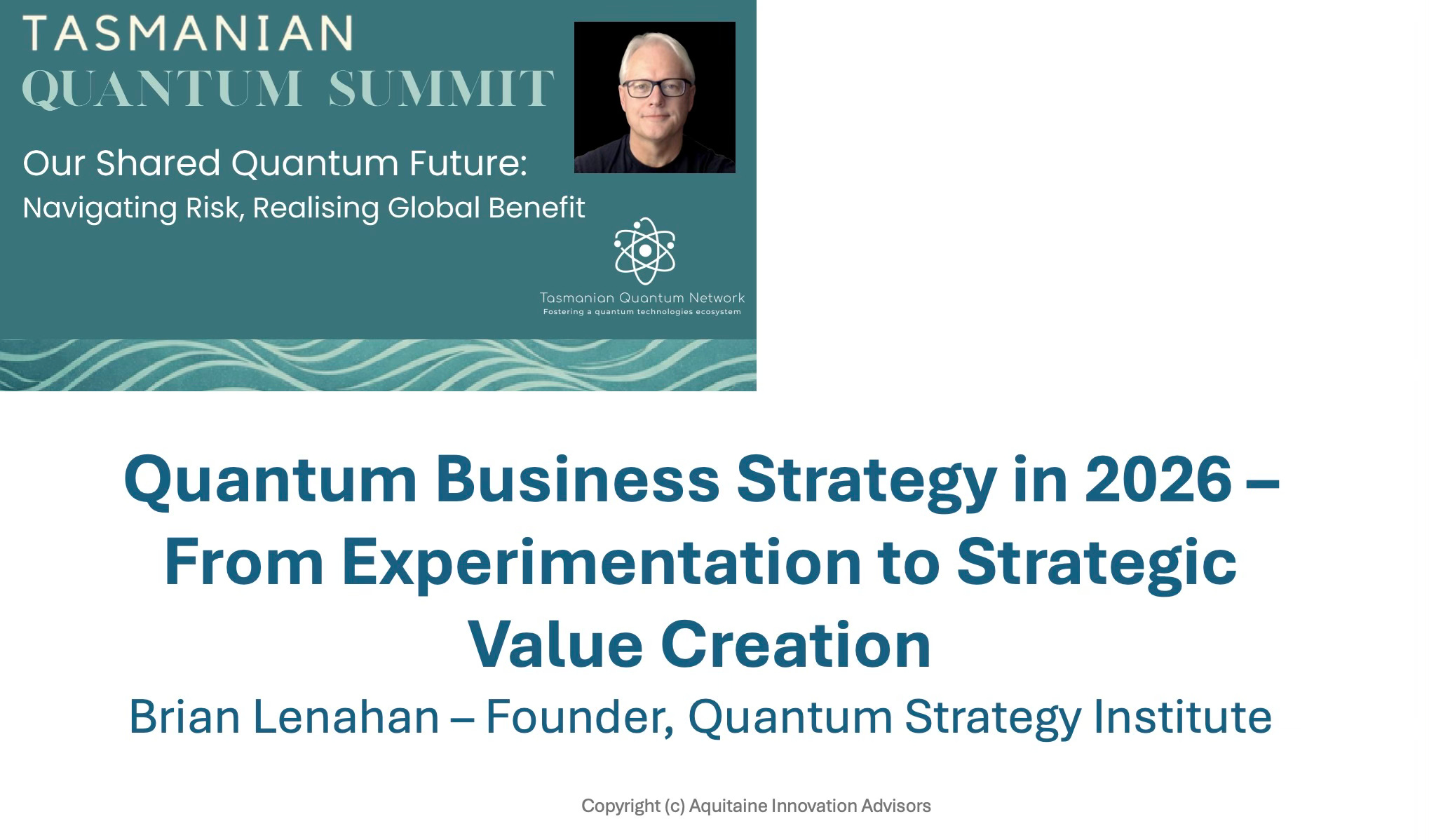
Image source: Brian Lenahan/TQN
AGENDA
1. The 2026 quantum reality – where we actually are.
2. A practical five-layer framework to turn quantum from experiment into strategy.
3. Actionable steps you can take this year
The 2026 Quantum Landscape – NISQ is Dead. Long Live Hybrid
By May 2026, the narrative has shifted. The noisy intermediate-scale quantum (NISQ) era we obsessed over in 2023–2024 is effectively over. We are now in the early hybrid era. Fault-tolerant logical qubits are no longer laboratory curiosities. Companies like Quantinuum, IonQ, IBM, and PsiQuantum have demonstrated systems with enough high-fidelity qubits and error correction to run meaningful hybrid quantum-classical workloads at scale. Google’s Willow-class chips and D-Wave’s Advantage2 processors are already being accessed via cloud platforms. What does this mean for business?
Three big shifts:
First, Quantum-as-a-Service (QaaS) is mainstream. You no longer need a cryogenic lab in your basement. IBM, AWS Braket, Microsoft Azure Quantum, and Google Cloud are offering pay-as-you-go access with user-friendly SDKs. Australian organisations can spin up a 50+ logical qubit circuit today for the price of a decent coffee run.
Second, hybrid workflows are the new normal. Quantum processors now handle the hard parts – optimisation, simulation, and certain machine-learning kernels – while classical supercomputers and AI do everything else. Enterprises are no longer waiting for “quantum supremacy”; they are building quantum advantage in narrow, high-value domains.
Third, the market is consolidating. We saw record investment in 2025, and 2026 has brought the first wave of serious M&A. Large tech players are acquiring cryogenic subsystems, photonics suppliers, and software toolchains. This is good news: it means the ecosystem is maturing and the risk of vendor lock-in is being managed through open standards.
NOTE: One of the audience members asked me to expand on why I stated that the NISQ era was “dead”. My response was that over the last few years, the target for a fault tolerant quantum computer (FTQC) has reduced from 30 years, to 25 years, to 20 years etc due to the advances in error correction and the ratio required between physical and logical qubits has reduced significantly to advance beyond noisy computing.
For Australia, this timing is perfect. The National Quantum Strategy, launched in 2023 and now delivering through the Australian Centre for Quantum Growth, positions you to be a sovereign player – not just in research, but in commercialisation. Tasmania’s own Quantum Network is a brilliant example of how geography is no barrier when vision and collaboration align. Your work with Indonesia and Papua New Guinea shows the region is ready to leapfrog.
The Five-Layer Quantum Strategy Framework
So how do you actually build a quantum business strategy in 2026? I’ve spent the last six years stress-testing this with executives across banking, resources, logistics and government.
Here is the five-layer framework – simple, sequential, and proven.
Layer 1: Awareness
Start with executive education and a quantum readiness assessment. Ask three questions:
Which of our intractable problems could benefit from exponential speed-up?
What is our current cryptographic exposure?
Where are our competitors or supply-chain partners already piloting quantum?
I recommend a one-day Quantum Literacy Workshop – I’ve run dozens of them. You’ll be amazed how quickly CFOs move from “this is magic” to “how soon can we model our ore-body optimisation?”
Layer 2: Capability
Build internal skills and secure infrastructure access. You don’t need 50 quantum physicists on payroll. You need 2–3 “quantum translators” who understand both business KPIs and Qiskit or PennyLane. Partner early with Australian universities and the growing pool of quantum talent coming out of the National Quantum Strategy programs.
Layer 3: Integration
Define use cases and build a three-year roadmap. Prioritise problems where quantum delivers 10x–1000x advantage:
Portfolio optimisation in finance
Molecular simulation in pharma and advanced materials
Supply-chain and logistics routing (critical for Tasmania’s export economy)
Climate and environmental modelling (huge for our agriculture and fisheries sectors)
Run small, low-cost proofs-of-concept on cloud QPUs. Measure not just technical fidelity but business ROI.
Layer 4: Governance
This is where many organisations stumble. Establish a Quantum Governance Committee that owns:
Post-quantum cryptography migration (NIST standards are live; start your crypto-agility project now)
Ethical use and IP protection
Geopolitical risk (sovereign capability matters in 2026)
Layer 5: Value Realisation
Scale what works. Track metrics that matter to the board: cost savings, revenue uplift, risk reduction. Celebrate wins publicly – your first successful hybrid quantum pilot is marketing gold in 2026.
Real-World Opportunities & Tasmanian/Australian Edge
Let me make this concrete with three sectors where Australian businesses – including those here in Tasmania – can win in 2026.
Resources & Mining – Optimisation of extraction routes, blending schedules, and environmental impact modelling. One major miner I advised reduced simulation time from weeks to hours using hybrid quantum solvers.
Cybersecurity & Critical Infrastructure – The summit program rightly highlights this. Quantum computers will eventually break RSA and ECC. Every organisation must be on a three-year post-quantum migration plan. Tasmania’s critical infrastructure and regional connectivity projects are uniquely positioned to lead in quantum-secure networking trials.
Sustainability & Climate – Quantum simulation of catalysts for green hydrogen or carbon capture is moving from theory to pilot. Australia’s National Quantum Strategy explicitly calls out these national priorities.
The beauty of 2026 is that you don’t need to be a global giant. Small-to-medium enterprises partnering with cloud providers and local research can achieve quantum advantage faster than many multinationals stuck in legacy procurement.
Risks, Challenges & Mitigation
A quick word on realism. The hype has not disappeared entirely. Some vendors will still over-promise. Talent remains scarce. Capital markets are watching closely after 2025’s funding surge. Mitigation is straightforward: stay vendor-agnostic, focus on hybrid, measure relentlessly, and collaborate. The Tasmanian Quantum Network model – open, inclusive, internationally connected – is exactly the right approach
Your 2026 Action Plan
Before I close, here is your simple 2026 action list:
Book a quantum readiness workshop for your leadership team before July.
Launch one proof-of-concept on a public cloud QPU by September.
Complete a post-quantum cryptography inventory by December.
Join or strengthen a quantum ecosystem – whether TQN, Quantum Australia, or an international partner.
Do these four things and you will enter 2027 ahead of 90 % of your competitors.
The Quantum Decade Begins Now
In 2026 we are no longer asking “if” quantum will matter – we are asking “how fast” and “who leads”. Australia’s National Quantum Strategy gives the policy tailwind. The Tasmanian Quantum Network gives us the community engine. And the technology is finally ready for business strategy, not just physics experiments.
Thank you all.
Brian Lenahan is founder and chair of the Quantum Strategy Institute, author of seven Amazon published books on quantum technologies and artificial intelligence and a Substack Top 50 Rising in Technology. Brian’s focus on the practical side of technology ensures you will get the guidance and inspiration you need to gain value from quantum now and into the future. Brian does not purport to be an expert in each field or subfield for which he provides science communication.
Brian’s books are available on Amazon. Quantum Strategy for Business course is available on the QURECA platform.
Copyright © 2026 Aquitaine Innovation Advisors