
Quantum Roadmaps Reviewed
The Pragmatic Push Toward Industrialization

Roadmaps are a fixture in the quantum vendor space. Forecasts of the next evolution of quantum hardware. Projecting out in time what the organization hopes will be the future capabilities for their offerings while end users anticipate real benefits to integrate into their IT infrastructures. The pragmatic push toward industrialization of quantum technologies.
(Read to the end to get an exciting preview).

Image source: Brian Lenahan/Midjourney
QEC Key
One key metric in any quantum vendor roadmap is “quantum error correction” or QEC which is a set of techniques essential for making reliable, large-scale quantum computers possible. Unlike classical bits, qubits are extremely fragile and prone to errors from noise, decoherence, imperfect gates, or environmental disturbances, which can flip bits, introduce phase errors, or cause complete loss of quantum information. QEC works by redundantly encoding the logical information of one “protected” qubit (called a logical qubit) across many physical qubits—often dozens to thousands—using specially designed quantum error-correcting codes (like the surface code or Shor code). This redundancy allows the system to detect errors through syndrome measurements (without collapsing the quantum state) and then correct them automatically, effectively suppressing error rates exponentially as more qubits are added, provided the physical error rate is below a threshold. In essence, QEC turns noisy, short-lived physical qubits into stable, fault-tolerant logical qubits capable of running long, complex computations, which is widely regarded as the key technical hurdle to achieving practical quantum advantage and utility-scale quantum computing.
Roadmaps
Several major quantum computing companies have published or updated quantum error correction (QEC)-focused roadmaps in recent years (primarily 2024–2026), often as part of broader fault-tolerant or utility-scale quantum computing timelines. These emphasize scaling logical qubits, reducing overhead via advanced codes (e.g., qLDPC, surface codes), real-time decoding, and achieving fault tolerance.
NOTE: Each produced roadmap is inherently self-promotional and historically quantum roadmap timelines have slipped, so each should be critiqued with these elements in mind.
First let’s take a look at some of the key players with notable recent QEC-related roadmaps or milestones (as of mid-March 2026):
IBM — IBM has one of the most detailed and frequently updated roadmaps explicitly incorporating QEC. In June 2025, they released papers and an updated plan for large-scale fault-tolerant quantum computing by 2029 (e.g., the “Starling” system with ~200 logical qubits running 100 million gates). Key elements include shifting to qLDPC (bivariate bicycle) codes for ~90% reduced overhead vs. surface codes, modular processors (Loon in 2025 for connectivity tests, Kookaburra in 2026 for qLDPC memory/processing, Cockatoo in 2027), real-time decoding on classical hardware (10x speedup achieved ahead of schedule in 2025), and demonstrations of error correction codes in 2025–2026. Their 2025–2029 roadmap integrates QEC as central to quantum advantage by 2026 and full fault tolerance by 2029 with the claim of “The first fault-tolerant quantum computer will be available to clients and allow execution of 100M gates on 200 qubits.”
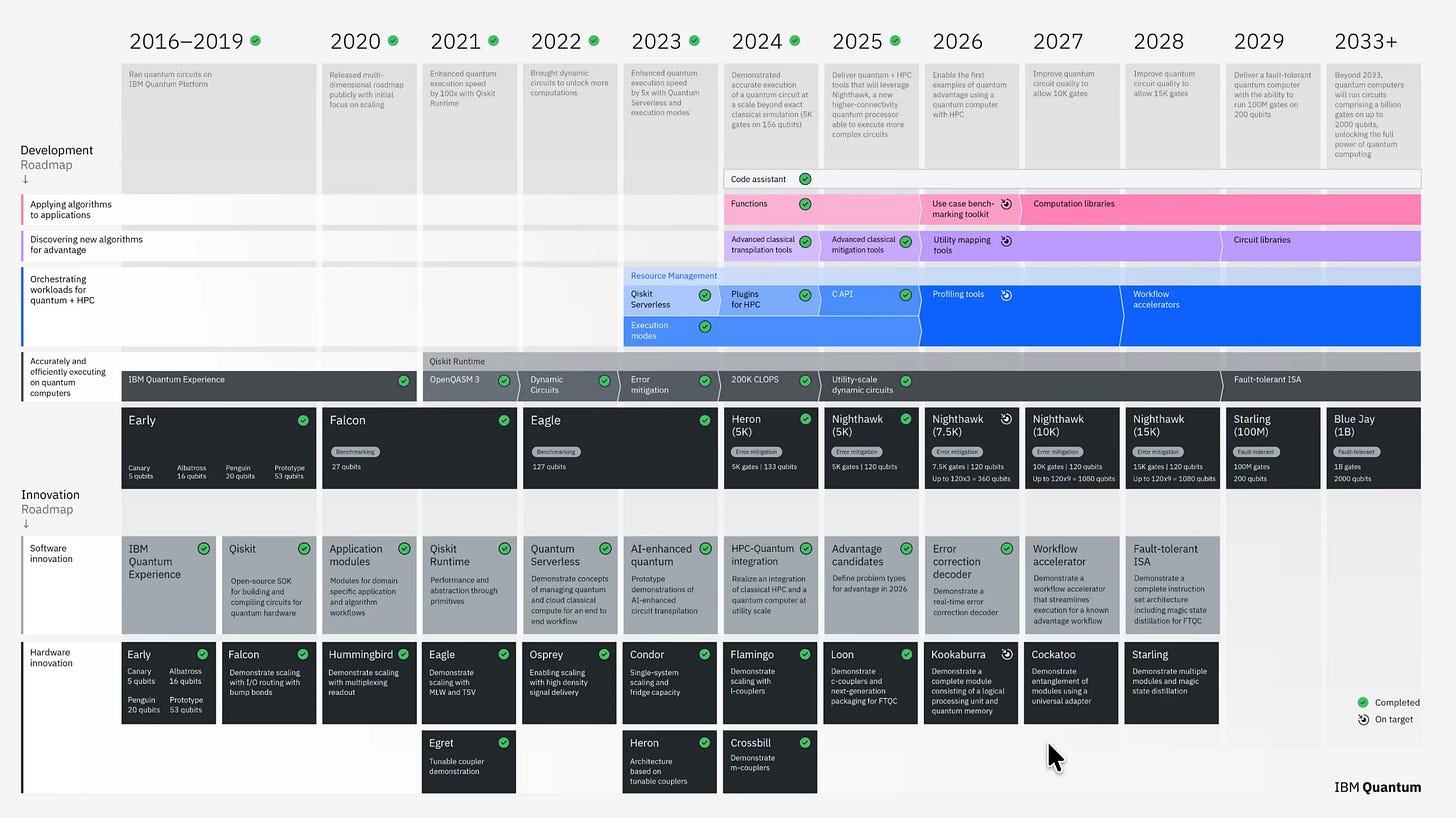
Image source: IBM
IonQ — IonQ’s public roadmap (updated as of 2025) targets fault tolerance with trapped-ion qubits, aiming for 2 million physical qubits and 80,000 logical qubits by 2030. It stresses efficient QEC to minimize overhead (high-quality physical qubits reduce correction needs), error correction at scale to yield usable logical qubits, and modular scaling. A November 2025 blog post discussed reimagining QEC codes tailored to trapped ions for better performance. It’s less granular on specific codes/decoders than IBM or Riverlane but commits to the “fastest path to fault tolerance” via their architecture.
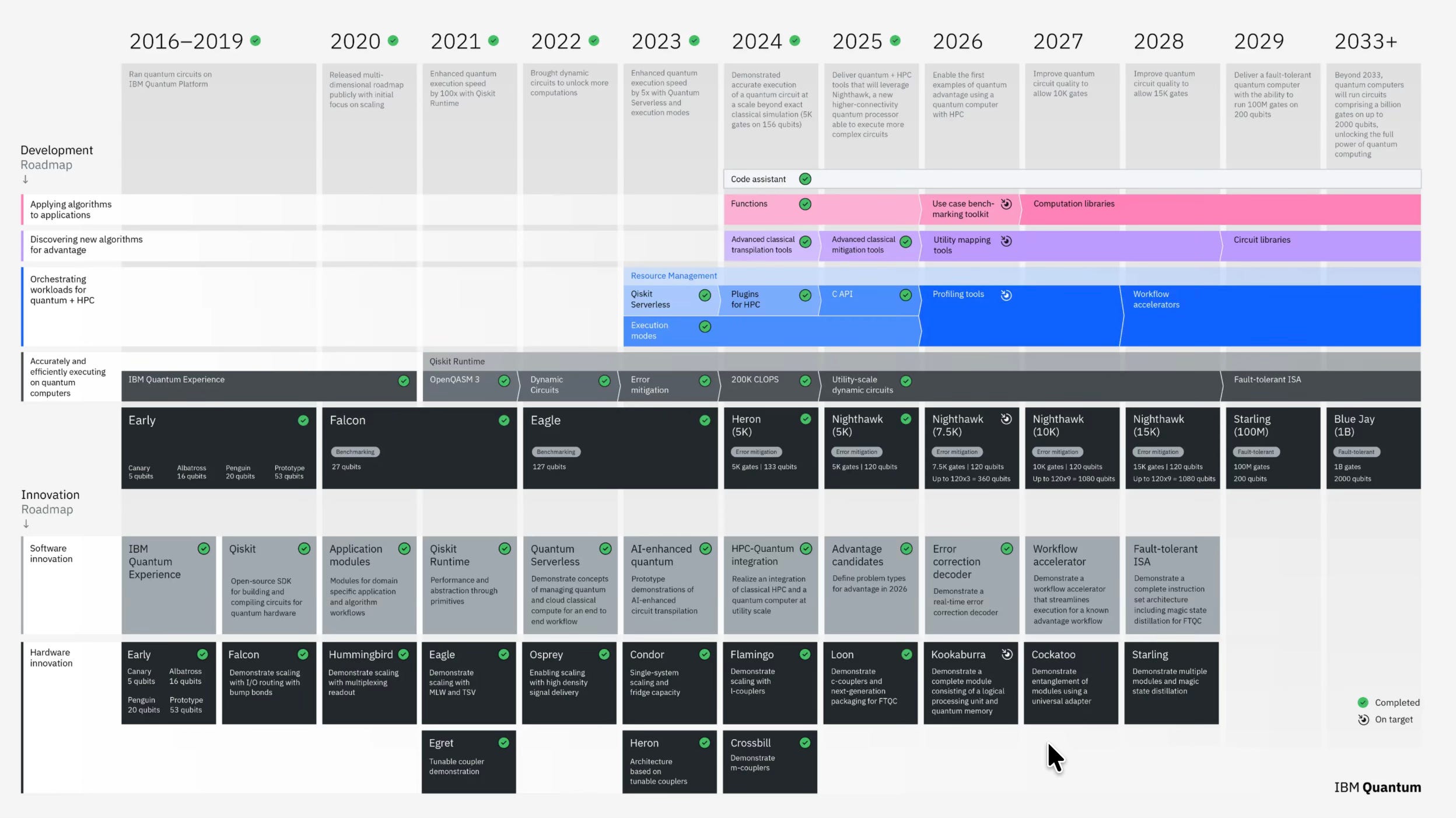
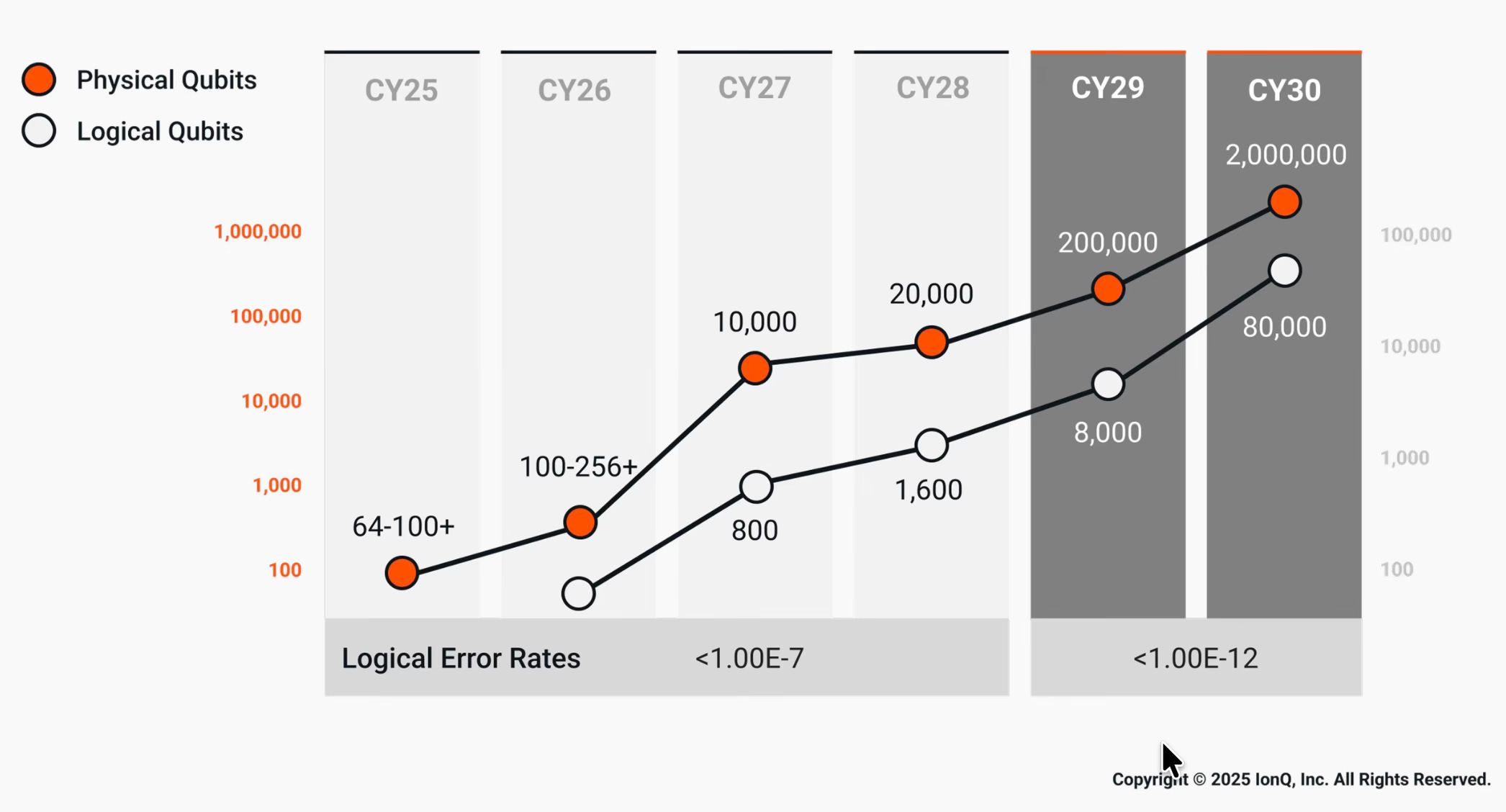
Image source: IonQ
Quantinuum — In September 2024, Quantinuum unveiled an accelerated roadmap to universal, fully fault-tolerant quantum computing by 2030, with the fifth-generation “Apollo” system featuring thousands of physical qubits, hundreds of logical qubits, millions of gates, and low error rates. It highlights real-time fault-tolerant error correction, high-rate/high-distance QEC codes leveraging their all-to-all connectivity and trapped-ion advantages (e.g., single-shot correction, potential logical error rates to 10⁻¹⁰). Milestones include Helios (2025, with efficient logical qubits like 48 error-corrected from 98 physical), Sol (2027), and Apollo (2029–2030). They’ve demonstrated repeatable error correction and universal gate sets (June 2025 papers), positioning it as highly de-risked. Updates continued into 2025–2026 with efficient codes and simulations.
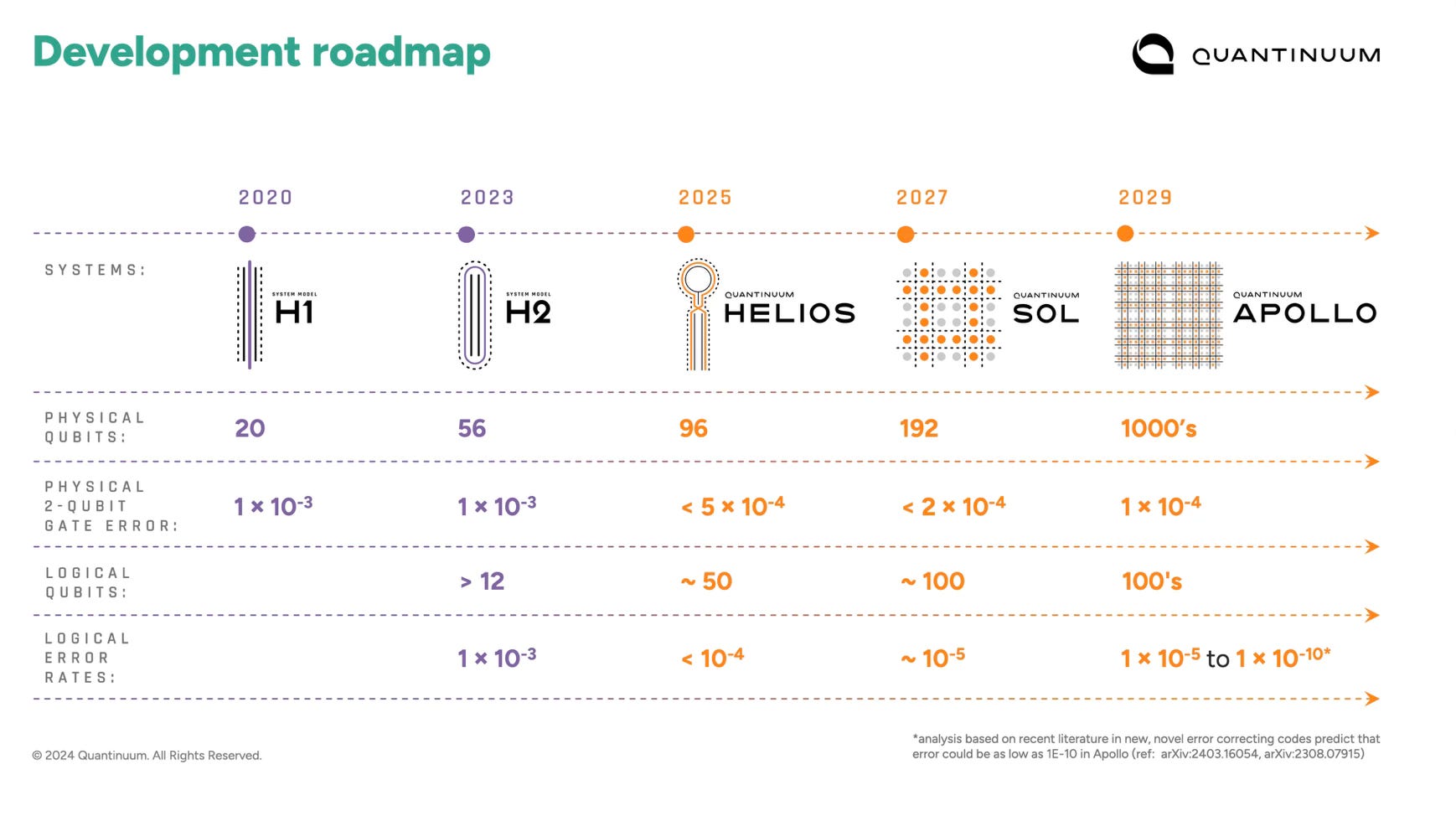
Image source: Quantinuum
Riverlane shared its latest QEC roadmap (below). Being the most recent, we can take a deep dive into the roadmap focusing on core claims, strengths and cautions.
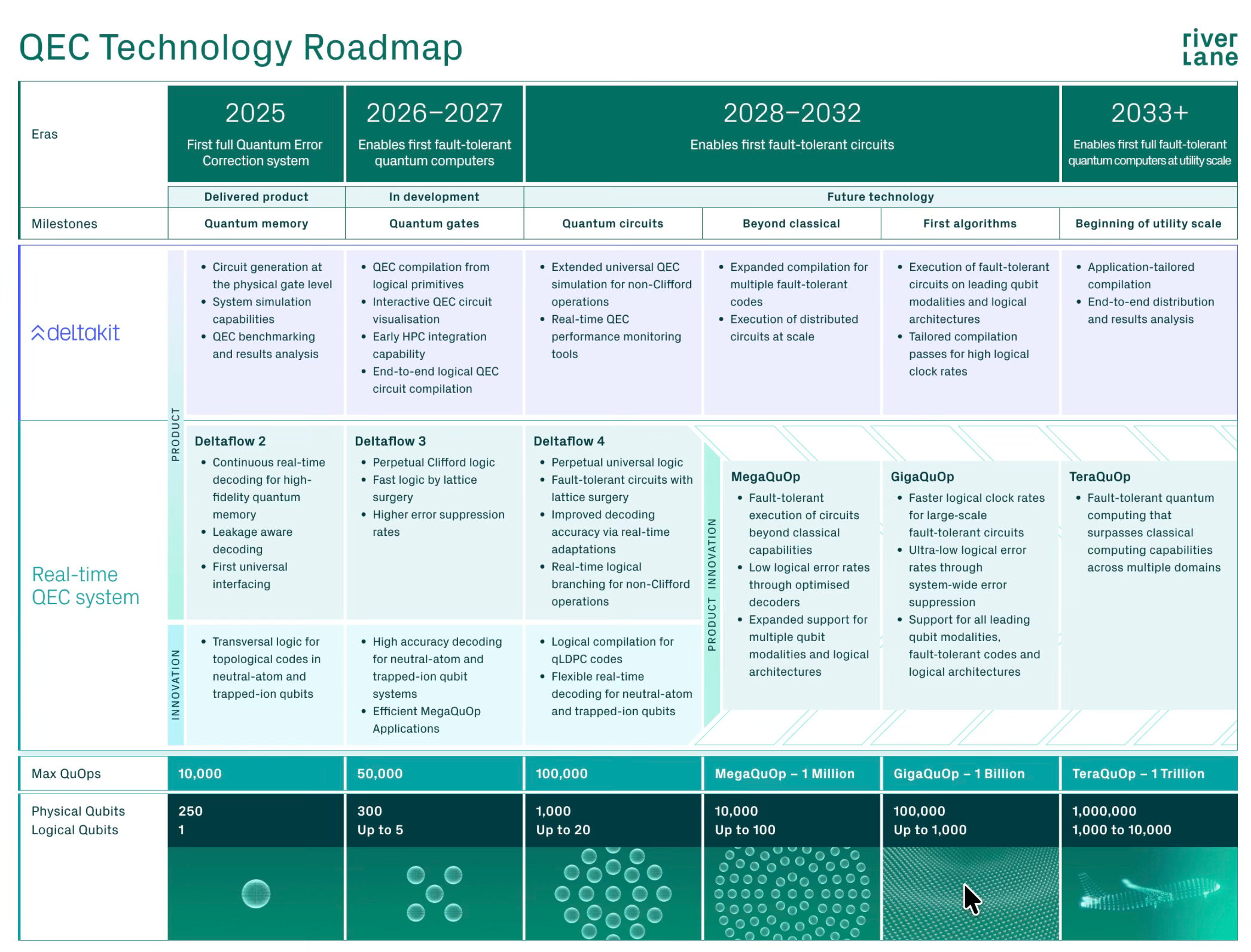
Image source: Riverlane
Core Claims and Structure of the Riverlane Roadmap
The Riverlane roadmap builds directly on a December 2025 Nature Communications paper (peer-reviewed) demonstrating that Riverlane’s LCD decoder enables certain quantum systems (e.g., superconducting qubits) to achieve 1 million error-free operations (MegaQuOp scale) with up to 4x fewer physical qubits — translating to a ~75% reduction in qubit overhead for surface-code implementations (e.g., halving code distance from d=33 to d=17 in leakage-prone systems). the roadmap extends this efficiency gain across all major qubit modalities (superconducting, trapped ions, photonic, neutral atoms, etc.), addressing the “avalanche effect” of cascading errors that currently limits scale. Further it defines three successive generations of fault-tolerant systems, each scaling reliable quantum operations (QuOps) by ~1,000×:
MegaQuOp (1 million reliable ops): Targeted before the end of the decade (2029–2030). Enables hybrid quantum-AI systems for specialized problems in materials science/chemistry that surpass classical supercomputers.
GigaQuOp (~1 billion reliable ops): Early 2030s. Supports complex algorithms and the first wave of true commercial applications (e.g., high-fidelity molecular modeling for drug discovery, energy materials).
TeraQuOp+ (implied further scaling): Toward fully universal utility-scale by ~2033+, with billions to trillions of ops for broad industrial/scientific impact.
Emphasizes real-time, low-latency decoding on scalable FPGA hardware to handle terabytes/second of syndrome data, overcoming the central bottleneck in QEC.
The roadmap includes a detailed whitepaper with phased milestones from foundational quantum memory experiments to full fault-tolerance.
Strengths and Positive Aspects
Riverlane’s roadmap is certainly grounded in recent peer-reviewed work. The LCD breakthrough provides credible evidence for the claimed efficiency gains, especially in reducing physical qubit overhead (a major cost driver). This isn’t just marketing; it’s published science. By targeting compatibility with every major qubit type, Riverlane positions itself as a “neutral” QEC layer (like a software stack), which could accelerate industry-wide progress rather than tying to one hardware vendor. QEC is now widely seen as the #1 bottleneck for utility-scale QC (as echoed in Riverlane’s own 2025 QEC Report and industry consensus); Their focus on real-time decoding at MHz speeds addresses a genuine pain point. And finally, if the 4x qubit reduction generalizes well, it could shave years off timelines by making fault-tolerance feasible with fewer resources, aligning with broader optimism around qLDPC/surface code hybrids and decoder optimizations.
Critiques and Areas of Caution
While the LCD paper shows strong results for specific setups, extrapolating that to a full 3–5 year speedup across all qubit types and to utility-scale is a big leap. Real-world scaling involves many other factors (e.g., cryogenic engineering, control electronics, logical gate fidelities beyond just decoding, integration with hardware-specific noise models). Independent validation on diverse platforms will be needed; current evidence is strongest for superconducting/leakage scenarios. Next, the headline 75% overhead reduction applies to surface codes with the LCD - while surface codes remain a leading candidate, the field is shifting toward more efficient codes (qLDPC, color codes, etc.) that might achieve similar or better overheads natively. Riverlane’s approach could be overtaken if hardware vendors optimize for those. Third, MegaQuOp by late 2020s is aggressive (though not impossible with rapid progress); GigaQuOp in early 2030s assumes smooth compounding of improvements; historical quantum roadmaps (from IBM, Google, etc.) have often slipped due to unforeseen engineering hurdles. Fourth, as a vendor selling Deltaflow (QEC-as-a-service/stack), the roadmap naturally highlights their tech as the key enabler. It downplays complementary advances from others (e.g., better physical qubits, alternative codes/decoders from competitors like IBM’s qLDPC push or Google’s efforts). It’s a strong pitch for Riverlane’s stack but not a neutral industry forecast. Finally, the Nature paper is solid, but broader deployment/testing on real hardware at scale remains to be seen. Claims of broad acceleration need more cross-platform demos.
Ranking Based on Claimed Fastest to FTQC
The four companies—IBM, Quantinuum, IonQ, and Riverlane—have published roadmaps with varying levels of specificity on achieving fault-tolerant quantum computing (FTQC), meaning systems with fully error-corrected logical qubits capable of running long, reliable computations at scale (often tied to “utility-scale” or commercial tipping points). Ranking them from fastest (earliest claimed milestone for meaningful FTQC, such as a first fault-tolerant system, universal fault-tolerant machine, or utility-scale entry) to slowest, based on their stated timelines as of March 2026 is a challenge since these are company claims and predictions as opposed to real world FTQC outcomes. Quantinuum targets a fully fault-tolerant and universal quantum computer (Apollo system) by 2030 (end of the decade), with millions of gates on hundreds of logical qubits, delivering scientific advantage and a commercial tipping point being more aggressive and hardware-specific than others for full universality/fault tolerance. IBM remains a strong contender for early meaningful FTQC with their detailed roadmap commits to delivering the first fault-tolerant quantum computer (Starling system) in 2029, with ~200 logical qubits running 100 million gates, available to clients and IBM’s shift to efficient qLDPC codes and real-time decoding supports this timeline, making it one of the most concrete for a client-accessible FTQC system. IonQ has ambitious scaling but slightly later explicit FTQC emphasis. Their roadmap (updated post-2025 acquisitions like Oxford Ionics) targets 2 million physical qubits and 80,000 logical qubits by 2030, with logical error rates low enough (<10⁻¹²) for powerful fault-tolerant applications. They describe a “fastest path to fault tolerance” via trapped-ion advantages, modular/photonic interconnects, and high-fidelity qubits, but the 2030 milestone focuses on large-scale logical qubits rather than naming a specific “first FTQC” year earlier. This positions them competitively for massive scale by the early 2030s. And Riverlane is a QEC software/tools provider (not building full quantum computers) yet their March 2026 QEC roadmap claims their decoder/stack (e.g., Deltaflow, Local Clustering Decoder) can accelerate others’ paths to utility-scale FTQC by 3–5 years, targeting MegaQuOp (1 million reliable ops) before 2030, GigaQuOp by early 2030s, and TeraQuOp+ from 2033+.
NOTE: Todays’ Quantum’s Business analysis does not include a myriad of other quantum companies who may win the race to FTQC, however the roadmap analysis exercise illustrates the general timeframes vendors are working towards.
Caveats on the Ranking
Timelines are self-reported company claims (often optimistic/promotional), not independently verified achievements. “Fault-tolerant” definitions vary slightly (e.g., first logical qubits vs. full universal/utility-scale). Hardware leaders (Quantinuum, IBM, IonQ) tie FTQC to their own systems, while Riverlane accelerates the field broadly. Progress depends on engineering breakthroughs, and historically quantum roadmaps have slipped. It will be critical to watch 2026–2027 demos (e.g., logical qubit scaling, real-time correction) for real momentum and real world progress.
Preview
For paid subscribers, you will receive the first preview of my own company roadmap from 2026 to 2030 where I illustrate my plans for thought leadership, consulting, writing and public speaking and paid subscribers can share their thoughts.
Summary
Roadmaps tell the world about real and planned progress. Yet the wise organization leader looks at quantum technology as something they need to prepare for today.
Brian Lenahan is founder and chair of the Quantum Strategy Institute, author of seven Amazon published books on quantum technologies and artificial intelligence and a Substack Top 50 Rising in Technology. Brian’s focus on the practical side of technology ensures you will get the guidance and inspiration you need to gain value from quantum now and into the future. Brian does not purport to be an expert in each field or subfield for which he provides science communication.
Brian’s books are available on Amazon. Quantum Strategy for Business course is available on the QURECA platform.
Copyright © 2026 Aquitaine Innovation Advisors
Great article - thanks Brian.