
Analysing Google's Modality Shift
Dual Track Strategy

Google’s recent “quantum modality shift” refers to their March 2026 announcement that Google Quantum AI is expanding beyond its decade-long focus on superconducting qubits to also pursue neutral atom quantum computing as a second hardware modality.
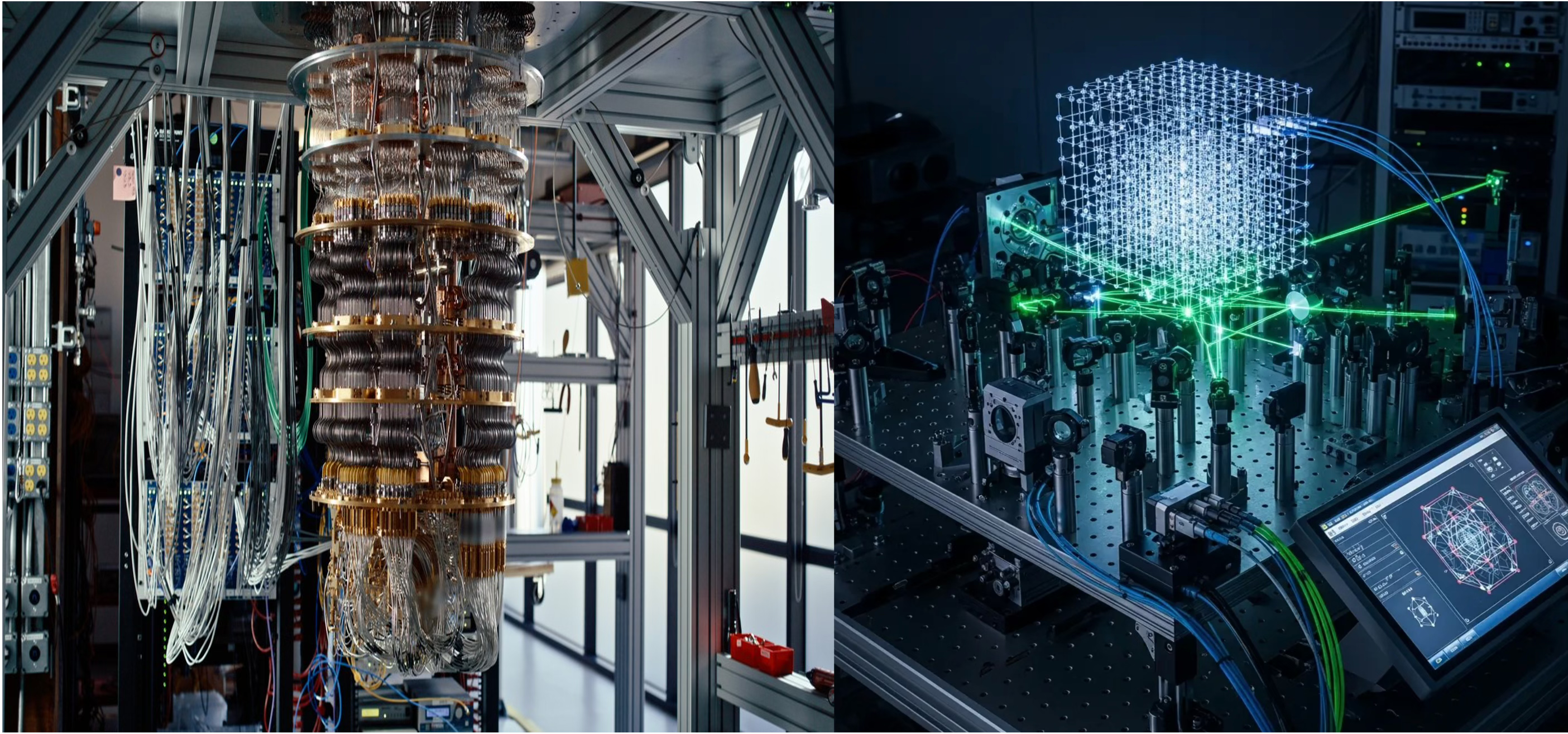
Image sources: Google Blog/Quantum Zeitgeist
“We are now increasingly confident that commercially relevant quantum computers based on superconducting technology will become available by the end of this decade. Today, we are excited to share that Google Quantum AI is expanding our quantum computing effort to include neutral atom quantum computing, which uses individual atoms as qubits.” - Helmut Neven, Founder and Lead, Google Quantum AI
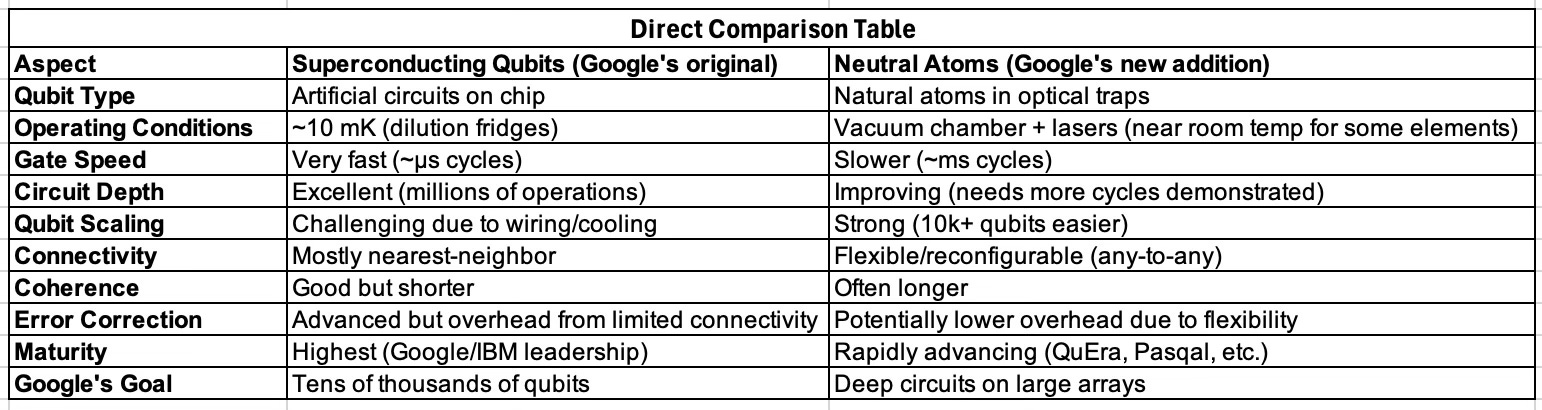
This is not a full replacement but a deliberate dual-track strategy to accelerate progress toward large-scale, error-corrected quantum computers by leveraging the complementary strengths of each approach. Google (via Hartmut Neven) describes it as exploiting the “space-time trade-off”: superconducting systems excel in the timedimension (deep circuits with millions of fast gate cycles), while neutral atoms shine in the space dimension (scaling to thousands of qubits with flexible connectivity).
To understand the differences between these two modalities, here is a side-by-side comparison in the context of Google’s shift:
Superconducting Qubits (Google’s Core/Original Modality)
How they work: Tiny superconducting circuits (transmon qubits) on chips cooled to near absolute zero (~10-20 mK) in dilution refrigerators. Information is stored in microwave photons/resonances.
Key strengths:
Extremely fast gate operations (nanoseconds to ~1 microsecond per cycle).
Proven deep circuits: Google has demonstrated millions of gate/measurement cycles.
Mature fabrication (chip-like, compatible with semiconductor tech).
Demonstrated quantum advantage (e.g., Sycamore/Willow processors).
Challenges:
Requires extreme cryogenic cooling and complex wiring (scales poorly for very large qubit counts).
Sensitive to noise/decoherence.
Limited native connectivity (mostly nearest-neighbor; requires extra couplers for long-range).
Google’s focus in dual roadmap: Scale architectures to tens of thousands of qubits while maintaining speed.
Google’s Willow superconducting quantum chip (example of their hardware).
Neutral Atom Qubits (Google’s New Modality)
How they work: Individual neutral atoms (e.g., rubidium or ytterbium) trapped in arrays using optical tweezers (focused lasers). Qubits encoded in hyperfine or Rydberg states; gates via laser pulses or Rydberg interactions. Operates in vacuum but without extreme cryogenics.
Key strengths:
Easier scaling to large qubit counts (already demonstrated ~10,000-qubit arrays by the field).
Identical, natural qubits (low manufacturing variability).
Long coherence times and reconfigurable arrays → any-to-any (flexible) connectivity.
Lower sensitivity to electromagnetic noise (no net charge).
Efficient for error correction due to long-range interactions and atom shuttling.
Challenges:
Slower gate speeds (~milliseconds per cycle).
Requires precise laser control and vacuum systems.
Less mature for deep circuits (fewer demonstrated multi-cycle operations compared to superconducting).
Google’s focus in dual roadmap: Demonstrate deep, many-cycle circuits on large arrays; adapt quantum error correction to the unique connectivity.
Why This Dual-Modality Approach (Google’s Rationale)
Google is not abandoning superconducting qubits—they remain confident in reaching commercially relevant systems by the end of the decade. Instead, adding neutral atoms hedges risks, enables cross-pollination of ideas (e.g., error-correction techniques), and targets different strengths for real-world problems in chemistry, materials, and optimization. Dr. Adam Kaufman (JILA/CU Boulder expert) is leading the new neutral-atom team in Boulder, Colorado, to build on the region’s atomic physics ecosystem.
Summary
Google’s shift illustrates a maturing quantum industry view: no single modality wins everything. Superconducting provides speed and proven performance; neutral atoms offer scalability and flexibility. By pursuing both, Google aims to reach useful, fault-tolerant quantum computing faster than with one path alone. This “two-lane roadmap” is a smart hedge seen across the field as neutral-atom platforms (from companies like QuEra and Atom Computing) continue to advance rapidly.
Sources:
UK AI and Quantum Tech Will Receive £2.5B by Ashley Montanaro, CEO and Co-Founder of Phasecraft
Google Says, “Prepare for Q-Day by 2029” by Ross Coffman, Lieutenant General, U.S. Army (Ret.) and Pres. of Forward Edge-AI
Google Accelerated its PQC migration to 2029 by Stefan Deiss, CEO and Co-Founder of The Hashgraph Group
Google’s Quantum Readiness Timeline by Rebecca Krauthamer, CEO and co-founder of QuSecure
Brian Lenahan is founder and chair of the Quantum Strategy Institute, author of seven Amazon published books on quantum technologies and artificial intelligence and a Substack Top 50 Rising in Technology. Brian’s focus on the practical side of technology ensures you will get the guidance and inspiration you need to gain value from quantum now and into the future. Brian does not purport to be an expert in each field or subfield for which he provides science communication.
Brian’s books are available on Amazon. Quantum Strategy for Business course is available on the QURECA platform.
Copyright © 2026 Aquitaine Innovation Advisors
Not really surprised -I belive that many different modalities will surface as being useful, depending on use case.